An electric car has one or two inlets, and they answer different questions: the AC socket you use every night and the DC one you use on a trip. In Australia the two are usually the same socket — CCS2 takes a Type 2 plug for slow charging and a CCS2 plug for fast. The finder below reads both inlets from the vehicle catalogue, and says so when it has neither.
Plug finder · 211 models
Find your car’s connectors
Two letters is enough to search. The answer is the inlet, not the badge — a model year can change it.
Start with one of these
The plugs, and how much of each exists
Every station count on this page comes from the same build-time copy as the directory, so a number here and a number on a connector hub are the same count.
| Plug | Carries | Stations | 50 kW or more | Models here | What it fits |
|---|---|---|---|---|---|
| Type 2 | AC / DC | 838 | 51 | 199 | AC charging on nearly every EV sold here |
| CCS2 | DC | 377 | 268 | 197 | Fast charging on most EVs sold here |
| CHAdeMO | DC | 149 | 90 | 2 | Early Leafs and Japanese imports |
Counts are records in this directory, not market totals: a car can list two inlets and a station can carry two plugs. Type 2 never delivers DC — the 51 stations that list it and report 50 kW or more hand that power out through a CCS2 plug on the same cabinet.
Why one socket takes both plugs
CCS2 is a Type 2 face with two DC pins added underneath. That is not a naming convention: it is the same moulding, which is why all 197 models here that list a CCS2 fast inlet also list Type 2 as an AC inlet. The car has one socket with two ways in — seven pins for AC, the two pins below them for DC — and the station decides which it hands you.
So the cable you need follows the post, not the car: a Type 2 cable at a motel charges the same car that a CCS2 cable charges on a highway, and neither needs an adapter. A car whose socket has no pins below the ring is the exception — it takes the AC cable and nothing else, which is why the finder shows two inlets rather than one badge.
Every model in the catalogue whose socket is recorded lists a DC inlet beside its AC one, which matches the cars themselves: a CCS2 socket is what most manufacturers fit now, and a pure AC socket is the older or the cheaper trim.
Why some models have no inlet listed
The inlets in this catalogue come from a reviewed registry: each entry states a model’s AC and DC plug and the page the claim came from, and an entry that matches no model fails the build. 199 of the 211 models are covered that way.
The other 12 keep a flag instead of a guess. Their model page prints the directory’s fallback rather than a plug, and the finder above says “not recorded” rather than “none”. A plausible CCS2 on a car that turned out to have CHAdeMO would be wrong in the one place a reader checks it, so the answer is missing rather than guessed — and a key that matches no model is a build failure precisely so the list cannot drift.
The plug also does not tell you the speed. 787 of the 838 stations that list Type 2 report less than 50 kW — but 51 of them report more, because a CCS2 site usually lists both plugs on the same cabinet. The cable you plug in is what decides: Type 2 gives you AC speed however fast the post is.
Adapters: what bridges what
| Your inlet | The post | What you need | Then |
|---|---|---|---|
| CCS2 | Type 2 | Nothing — a Type 2 plug fits the socket | AC speed only, whatever the post's rating |
| Type 2 only | CCS2 | Nothing sold in common use | The car stays on AC charging; the DC pins have nowhere to go |
| CCS2 | CHAdeMO | CHAdeMO-to-CCS2 adapter | Uncommon, and the car's software can refuse it |
| Type 2 + CHAdeMO | CCS2 | CHAdeMO-to-CCS2 adapter | Uncommon; the car fast-charges on CHAdeMO as it is |
| Any | Household or caravan socket | Your own charging cable | About 2.4–3.6 kW, with a cable rated for the socket |
An adapter is car-side and never raises the rate: the session runs at the lower of the two limits. Fit is a physical question, and the car also has to accept the adapter — many do not.
The one thing to check before buying an adapter
The shapes are easy to tell apart once you have seen them, and almost impossible to describe over the phone to a driver at a broken post. 3 photos, 3 answers, one tell each.
Game · 3 photos · name the plug
Which plug is this?
1 / 3 · 0 right
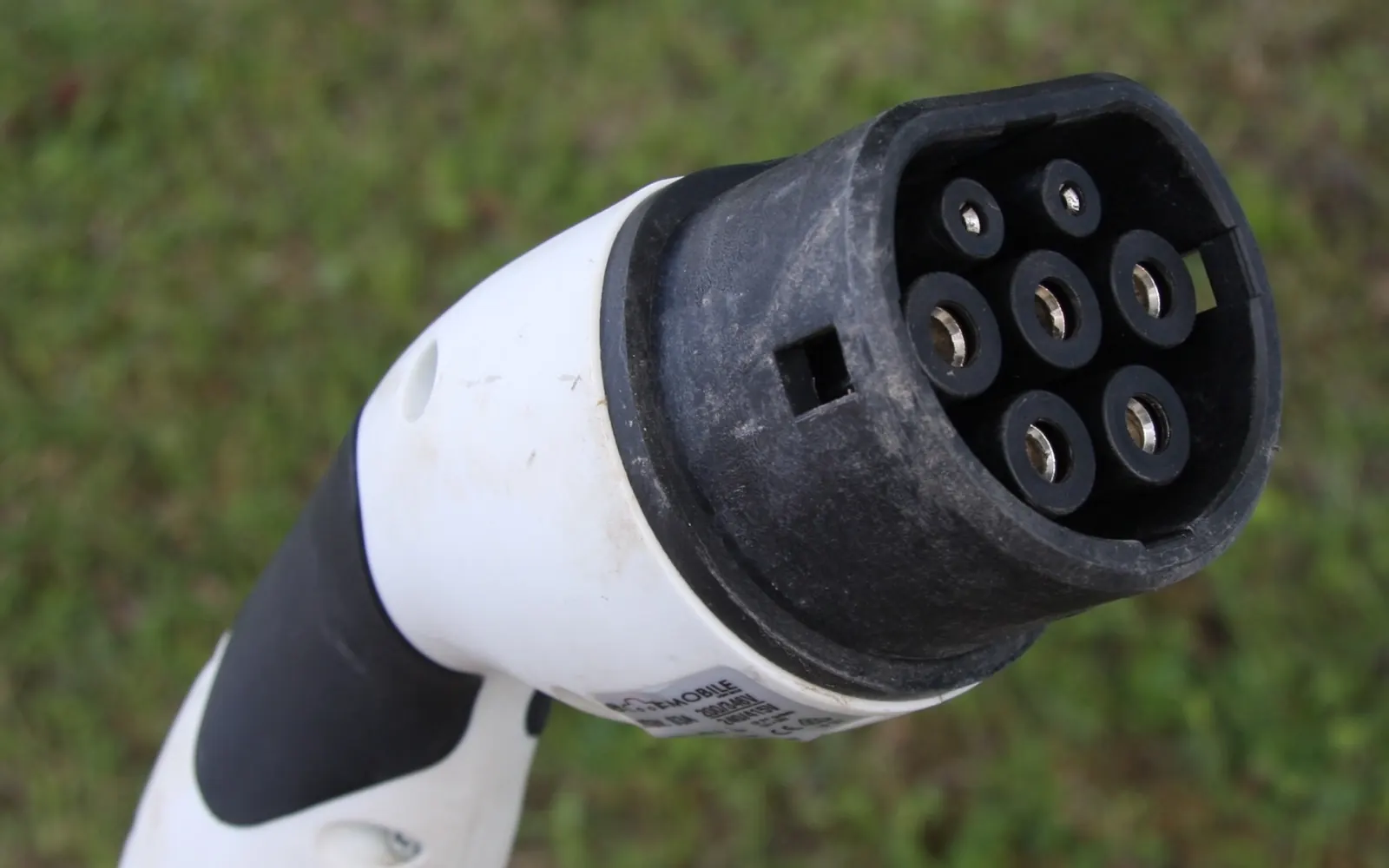
Name the plug in the photo. The answer is the standard, not the network.
Count the pins if you can see the face. The two that share a family are the ones people lose.
Check it in 30 seconds
- Look at the socket: seven small pins in a ring is Type 2, the same ring with two heavy pins below it is CCS2, and a body the size of a fist with two large pins is CHAdeMO.
- Read the charging section of the owner's manual and write down the two standards it names. Most cars sold here say CCS2 for DC and Type 2 for AC, on the one socket.
- For a car you are buying, ask for a photo of the inlet or open its page here. An imported car can have a different port from the same name sold new today.
- For a rental, check whether the listing is a tethered cable or a socket. A caravan park or motel may offer the socket and expect you to bring the cable.
Browse cars and stations by plug
Each connector hub lists the cars that list the plug and the stations that take it, and every model page carries the inlets this catalogue has verified — or says plainly that it has none.